
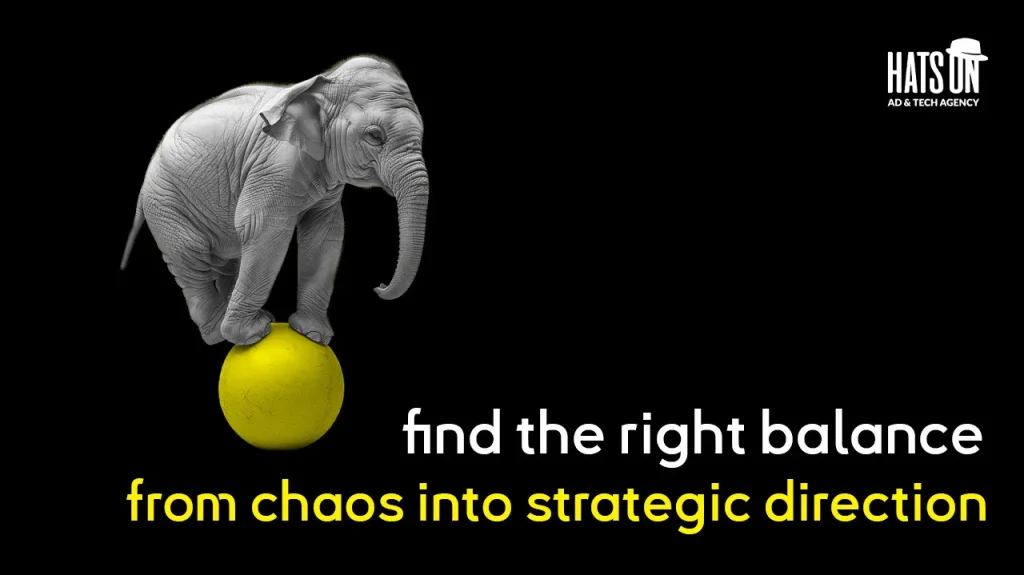
Find the Right Balance:
From Chaos Into Strategic Direction
The first weeks of the year always feel heavier than expected. Teams return from the holidays with full inboxes, delayed decisions, half closed projects and an unspoken pressure to move fast. Everyone wants momentum. Everyone wants results. And yet, many organisations feel oddly stuck. Not because they lack ambition, but because clarity is missing.
This is usually the point where marketing becomes overwhelming rather than enabling. Marketing suddenly sits among finance catch ups, operational fires, HR priorities, supplier renegotiations and leadership alignment. For some businesses, it drops down the list entirely. For others, it triggers reactive decisions. A campaign rushed out because something needs to happen. A budget pushed into ads without a clear role. A brief that starts with “we need visibility” and ends there. Both paths lead to the same outcome: activity without direction.
What most businesses experience in January is not a marketing problem, but a prioritisation problem. Marketing strategy is often misunderstood as a document or a long term brand exercise, when in reality its most valuable role is far more practical. Strategy exists to reduce noise, not add complexity. A strong strategy does not answer what should we do this year. It answers what should we not do right now. When everything feels urgent, prioritisation becomes the most valuable output marketing can deliver to leadership.
Without this filter, marketing teams are forced into constant reaction mode. Campaigns are approved late. Messaging changes weekly. Performance is judged in isolation rather than against a defined role in the business. Over time, marketing becomes tactical, defensive and disconnected from growth conversations. The organisation moves, but it does not move forward with intent.
Reactive marketing often looks productive on the surface. Launch something this week. Boost a post. Run a quick offer. Add another channel. The issue is not speed, it is intent. Reactive marketing optimises for short term reassurance rather than long term leverage. It absorbs budget, energy and attention without building momentum. Teams become execution machines instead of strategic partners, and leadership slowly loses trust in forecasts because outcomes feel inconsistent.
This is where frustration builds, especially for experienced marketing managers. The challenge is rarely a lack of ideas or capability. It is the absence of space to think, align and design a system that compounds over time. When marketing is constantly reacting, it never gets the chance to lead.
At senior level, the real value of marketing strategy lies in decision clarity. A good strategy makes trade offs explicit. It connects business goals to communication roles. It defines success beyond surface metrics and isolated campaigns. It answers which objectives matter most in this phase of the business, which audiences truly move the needle, which channels deserve consistent investment and which should remain experimental, and which messages must stay stable while others flex tactically.
When this clarity exists, execution accelerates rather than slows down. Teams move faster because alignment is already in place. Agencies perform better because expectations are clear. Leadership discussions shift from opinions to priorities. Marketing stops being a list of tasks and becomes a growth architecture.
January is often treated as a time to do more, but the real opportunity is to decide better. The businesses that gain an advantage early in the year are not the ones launching first. They are the ones pausing briefly to align intent before acting. They use this moment to challenge legacy activity, reset assumptions and reconnect marketing with real business pressure such as revenue targets, market conditions, internal capacity and competitive noise.
This work is uncomfortable because it forces choices. It requires saying no to activity that feels safe but delivers little leverage. Yet this is exactly what prevents the year from turning into another cycle of rushed campaigns and missed expectations.
Marketing strategy does not remove complexity. It gives it structure. In a year where attention is fragmented and pressure is high, the ability to prioritise with confidence becomes a competitive advantage. Not just for marketing teams, but for leadership as a whole. The real question at the start of the year is not what should we launch first, but what role marketing should play in helping this business win this year. Everything else should follow from that.
From our perspective, the businesses that navigate this moment best are not the ones chasing every opportunity, but the ones building a clear link between strategy, execution and accountability. When marketing is treated as a decision making system rather than a collection of outputs, it becomes easier to move with confidence, even in uncertain conditions. The role of leadership then shifts from approving activity to protecting focus, and marketing regains its place as a driver of structured growth rather than a reaction to urgency.