
The 2 Second Problem Nobody on Your Marketing Team Is Talking About
Most businesses blame the platform. The algorithm. The competition. The real problem is earlier than any of that.
You approved the budget. You briefed the team. You reviewed the creative, signed off on the edit and launched the campaign. The spend went out and the results came back underwhelming.
So you do what most businesses do. You increase the budget, tweak the targeting, test a different audience segment and try again.
But here is the question almost nobody asks: what actually happened in the first two seconds of that video?
Because in most cases, that is where the money went.
Video Is Not Optional Anymore
Regardless of your industry, your size or what you sell, if your business is not creating video content you are already behind. Video is no longer a format reserved for consumer brands with large production budgets. It is the primary way people consume information on every major platform. A law firm, an accountant, a construction company, a local retailer, a B2B software business. It does not matter. Your audience is watching video and your competitors are beginning to figure that out. The question is no longer whether your business should be making video. The question is whether your video is actually being watched.
The Platform Is Not the Problem
There is a conversation happening in almost every marketing meeting right now about rising CPMs, declining organic reach and increasing competition for attention on paid social. All of it is real. Platforms are more competitive than they were three years ago and that is not going to change.
But the businesses winning on those platforms are not winning because they have bigger budgets. They are winning because they understand something fundamental about how attention works in a scroll-based environment.
The average person scrolls through roughly 90 metres of content every single day. Facebook, Instagram, TikTok and YouTube Shorts are not passive viewing experiences. They are environments where the brain is making rapid filtering decisions almost continuously, deciding within fractions of a second what deserves attention and what gets ignored.
Your ad enters that environment and competes not just with other ads, but with content from friends, family, news, entertainment and everything else fighting for the same moment of attention.
You have approximately two seconds to interrupt that behaviour. If your video does not create curiosity, relevance or surprise in that window, the viewer scrolls past and your budget follows them.
What the Retention Data Actually Shows
Every platform gives you access to retention graphs. These charts show exactly how many viewers are still watching at each moment of your video. Most marketing teams glance at the overall view count and move on.
The detail that matters is what happens in the first two seconds.
For most underperforming ads, the retention curve drops sharply almost immediately. Not gradually. Not halfway through. Within the opening moments, a significant portion of viewers have already left.
This means the voiceover they recorded, the product demonstration they filmed, the offer they crafted and the call to action they spent time perfecting were never seen by a large portion of the people the budget reached.
The message was never the problem. The message never got the chance to be the problem.
Why Most Video Briefs Are Structured Backwards
The way most businesses brief video content follows a logical but ultimately flawed structure. It goes something like this: here is the product, here is the benefit, here is the offer, here is the call to action. Now make it look good.
The creative team builds the video in that order. The brand story comes first. The context comes second. The interesting part, if it exists, comes somewhere in the middle.
But the viewer does not have the patience for that structure in a scrolling environment. They are not sitting down to watch. They are moving. And something has to stop that movement before any of the carefully crafted content can land.
The hook the opening moment is not a creative detail. It is a strategic decision that determines whether everything else gets seen.
When a brief starts with the message and adds the hook as an afterthought, the result is usually a well-produced video that nobody watches past the first few seconds. When a brief starts with the hook what will interrupt scrolling, what will create curiosity, what will make someone pause the rest of the video has an audience.
The Fix Does Not Require a Bigger Budget
This is the part that should interest every business owner and CMO who has ever felt that social media advertising requires increasingly large investment to deliver increasingly modest returns.
The fix is not more spend. It is not better targeting. It is not a more sophisticated funnel.
It is a better opening two seconds.
A strong hook costs nothing additional to produce. It does not require a higher production budget, a more expensive creative team or a larger media buy. It requires a different way of thinking about how the video begins.
It requires asking, before anything else is decided: why would someone stop scrolling for this?
That question, asked early and answered well, changes the performance of everything that follows. Better retention in the opening seconds signals to the platform algorithm that the content is worth distributing more widely. More distribution means more reach from the same budget. More reach with better retention means lower effective cost per result.
The creative strategy compounds. The budget works harder. And the metrics that have been frustrating your reporting start to move in the right direction.
What This Looks Like in Practice
Strong opening hooks fall into a few categories. Some are visual an unexpected image, a sudden movement, a contrast that makes the brain pause to understand what it is seeing. Some are verbal an opening statement that introduces a curiosity gap, challenges an assumption or promises an insight. The most effective are often a combination of both.
The principle behind all of them is the same. The brain is drawn to novelty, incomplete information and pattern interruption. A hook works when it activates one or more of those responses in the first moment of the video.
This is not guesswork. It is the result of studying what actually holds attention across millions of pieces of short-form content and identifying the patterns that consistently perform.
The Question to Ask Before Your Next Campaign
Before your next video brief is approved, before the next campaign goes live, before the next budget is committed ask your team to answer one question about the opening two seconds of every piece of content.
Why would someone stop scrolling for this?
If the answer is not immediately clear, the video is not ready. Not because the production is wrong or the message is weak, but because the most important creative decision has not yet been made.
The platforms will keep getting more competitive. The budgets will keep being pressured. But the businesses that learn to win attention in the first two seconds will find that everything else the reach, the retention, the results becomes significantly easier to achieve.
Want to go deeper on this?
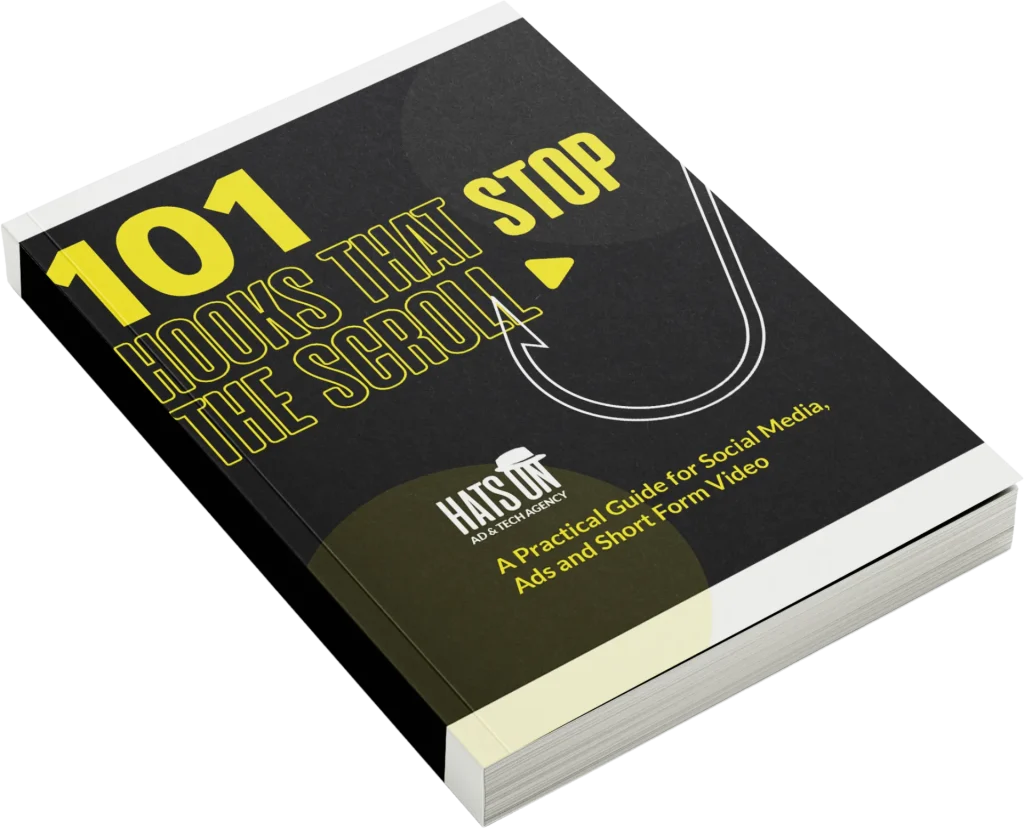
At Hats On, we have spent considerable time studying the mechanics of attention in short- form video and distilling those patterns into practical tools for brands and marketers. We put together a free resource that breaks down 101 specific hook techniques you can apply to your next campaign.